
- November 22, 2026
- drsfurtimann
- 0
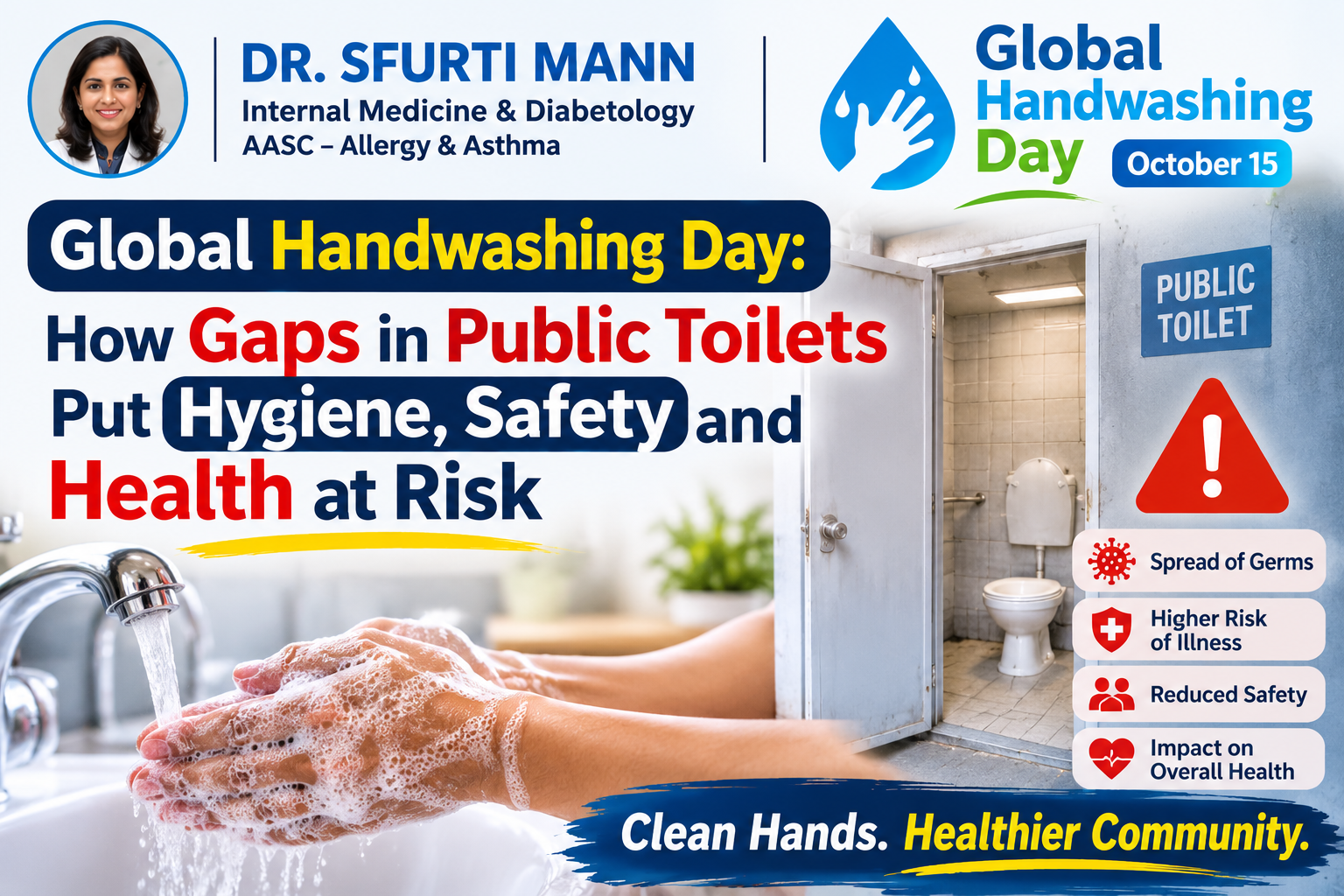
Every year on October 15, Global Handwashing Day reminds us that washing hands with soap is one of the simplest ways to prevent infection. But reports from Delhi and the NCR show a harder truth. For commuters, students, hospital visitors and street vendors, practising good hygiene is difficult when public toilets lack water, soap, working flushes or regular cleaning.
As a general physician in Gurgaon, Dr. Sfurti Mann says hand hygiene must be treated as a public health priority. People cannot be expected to maintain it if toilets are unusable, water is unavailable or soap is missing. Basic facilities must support awareness.
Why Handwashing Matters So Much
Clean hands stop the spread of germs and can save lives, especially where sanitation is poor. Good hand hygiene helps prevent:
- Stomach and gut infections, including diarrhoea and gastroenteritis
- Water- and food-borne illnesses such as typhoid
- Respiratory infections, including influenza and pneumonia
During flu outbreaks, hand hygiene becomes even more important. Our blog on precautions for diabetes patients during the H1N1 surge explains why.
What Delhi-NCR Reports Reveal About Public Toilets
Reports from across Delhi-NCR point to a problem that goes beyond whether a toilet exists. The real question is whether people can use it safely, affordably and with dignity.
- Over 33 percent of public toilets across civic zones in the national capital are reported to be unusable because of water shortages, broken flushes and poor maintenance.
- National Institute of Urban Affairs data show that busy commercial and transit areas in Delhi-NCR have fewer than one toilet seat for every 1,500 commuters. The urban planning standard is one seat for every 100 to 200 users.
- Commuters at railway stations describe toilets without water and soap that is dirty or diluted.
- Street vendors say flushes fail and water runs dry, even at toilets advertised as free.
H2: The Cost Burden on Daily Wage Workers
ActionAid Association field surveys from 2025 are reported to show that toilets advertised as free can charge street vendors and daily wage workers Rs 15 to Rs 30 a day. For a vendor earning Rs 300 to Rs 400 daily, that is a large share of income. Some people end up avoiding these facilities altogether, which harms both health and public cleanliness.
Schools and Hospitals Show the Gaps Clearly
Schools are where handwashing habits should begin, yet students report that soap is often missing or watered down, and that reminders fade after primary classes. The NITI Aayog School Education System Report cited in the coverage states that 61,540 schools lack usable toilets and 59,829 lack functional handwashing facilities. It also identifies 98,592 schools as lacking functional girls’ toilets.
Hospitals face their own problems. Families waiting for loved ones describe shared bathrooms where soap runs out, handwashing stations that are far from patient areas and charges of Rs 30 for a bath. For families already under financial strain, these costs add up.
A Gender Gap in Sanitation
The coverage also points to a gender gap. Of 3,192 public urinals catalogued across Delhi, only 132 are designed for women, and six of the Municipal Corporation of Delhi’s 12 zones reportedly have none. Praja Foundation figures cited estimate one public toilet seat for every 9,767 men and one for every 10,343 women. The Delhi High Court’s August 2026 directions on women-only sanitation facilities highlight the need to check that such facilities are available and working.
Can a Public Toilet Cause an Infection?
Poorly kept toilets can carry bacteria, and one patient in the report linked a urinary tract infection to a shared mall toilet. As the report itself notes, medical evidence is needed to trace any single infection to a specific toilet. What is clear is that unclean, unsupplied facilities raise the chances of infection. If you have burning while passing urine, fever or pain after using shared facilities, see a doctor and avoid self-medication.
How To Wash Your Hands the Right Way
Doctors recommend washing hands with soap for at least 20 seconds. Make sure you cover:
- Palms
- Backs of the hands
- Spaces between the fingers
- Thumbs
- Fingertips
Remove rings and wristwear before washing. Where possible, use a clean tissue or paper towel to turn off the tap or open the door, so your hands are not contaminated again.
When Should You Wash Your Hands?
- Before and after eating
- Before cooking
- After using the toilet
- After coughing or sneezing
- After touching surfaces on public transport, in gyms and in other shared spaces
Read more about the basics in our blog on why hand hygiene matters.
Can You Wash Your Hands Too Much?
Yes. Frequent washing with harsh products can strip the skin’s natural barrier and cause dryness, itching, cracking and dermatitis. Specialists advise:
- Use a mild, fragrance-free cleanser
- Apply a moisturiser with ingredients such as ceramides or glycerin, or petroleum jelly, after washing
- Avoid washing compulsively out of hygiene anxiety
Diluted soap is also a concern, since watering it down can let bacteria grow and defeat its purpose. If you have recurring skin reactions, our page on allergy treatment in Gurgaon can guide you.
How To Protect Yourself When Facilities Fall Short
- Carry a small bottle of alcohol based hand sanitiser, especially for travel, school and hospital visits
- Keep a pack of tissues or wipes for touching taps, handles and doors
- Use hands free seat openers or disposable seat covers where possible
- Carry your own water bottle and a small bar or pouch of soap when travelling
- Teach children to wash hands before meals and after play, and keep reminding them as they grow older
Sanitiser helps when soap and water are not available, but it is not a full replacement. Wash with soap and water as soon as you can.
Common Questions About Handwashing
Q. How long should I wash my hands?
At least 20 seconds with soap and clean water.
Q. Is hand sanitiser as good as soap and water?
Sanitiser is a useful backup when soap and water are not available, but washing with soap is the better option when you can.
Q. Can washing hands too often harm my skin?
Yes. Use a mild cleanser and moisturise afterwards to keep the skin barrier healthy.
Q. Does handwashing really prevent flu and stomach infections?
Yes. Clean hands help stop the spread of respiratory and stomach infections, including influenza and pneumonia.
Q. What should I do if public toilets have no soap or water?
Use sanitiser as a temporary measure, avoid touching your face and wash with soap and water at the first chance.
Talk to a Doctor You Can Trust
If you or your child has frequent stomach infections, skin irritation from handwashing or any infection that keeps coming back, a short consultation can help. Learn more about Dr. Sfurti Mann, see what patients say about her care or explore her full range of general physician services.
Visit Ananta Health Clinic in Sector 66, Gurgaon or book an appointment today. You can also contact the clinic with any question. Clean hands are a simple habit, and clean, working facilities make that habit possible for everyone.
Related reading:
- Hand hygiene: why is it so important
- Five precautions for diabetes patients during the H1N1 surge
- What borderline test results mean
- Silent diabetes symptoms people ignore
- More blogs
Reference:
Ankita Kumari. Global Handwashing Day: Indian Public Toilets Expose Gaps In Hygiene, Safety And Access. Source article